I once spent 45 minutes deciding between two almost identical restaurants. Same cuisine, same price range, same walking distance, same Google rating. By the time I picked one, I wasn't even hungry anymore. The decision ate my appetite. Literally.
If you've ever been stuck in one of those loops where you go back and forth between options and every time you lean one way your brain immediately serves up a reason to lean the other, you know exactly what I'm talking about. It's not that the options are bad. It's that they're too equal. And equal options are genuinely harder to choose between than obviously unequal ones.
That's where a decision wheel comes in. And before you roll your eyes at the idea of spinning a wheel to make your life choices, hear me out. There's actual psychology behind why this works, and it's not what you think.
What a Decision Wheel Actually Does

A decision wheel is a spinning wheel with your options on it. You add whatever choices you're stuck between, spin the wheel, and it randomly picks one. That's the surface level version.
But here's what actually happens underneath. The moment that wheel starts slowing down and approaching a specific option, you feel something. Relief? Dread? Excitement? Disappointment? Whatever that feeling is, it's your gut telling you what you already wanted before you even spun the wheel.
The wheel is a mirror, not a decision maker. It doesn't tell you what to do. It shows you what you already want to do by creating a moment where your honest reaction can surface before your analytical brain talks you out of it again.
Barry Schwartz literally wrote a book called "The Paradox of Choice" about this. More deliberation on equal options leads to worse outcomes and more regret. The wheel cuts through the deliberation by forcing a result. And since the options were roughly equal anyway, the outcome is fine either way.
The gut test: When the wheel lands on something and your first reaction is "wait, no, not that one," congratulations. You just figured out what you actually wanted. Use that information, not the wheel result.
When the Decision Wheel Genuinely Helps
This tool isn't for every decision. It's specifically for the category of choices where you've been going back and forth and neither option is clearly better. The kind of decision where a friend would say "just pick one, it doesn't matter."
Perfect situations for the wheel
- What to eat for dinner (the classic)
- Which movie to watch tonight
- Which task to work on first
- Where to go for a weekend trip
- Which book to start next
- Whether to go to the gym or skip today
- Which outfit to wear
- Which project to prioritize this week
- Where to go for happy hour
- Which podcast to listen to on the commute
Don't use the wheel for
- Career decisions that require proper research
- Medical choices
- Financial investments
- Anything with serious consequences for other people
- Legal decisions
- Anything irreversible where being wrong matters a lot
The pattern is pretty obvious. Low stakes, reversible, roughly equal? Spin the wheel. High stakes, irreversible, or you haven't done enough research? Don't use a random tool. Use your brain and maybe also a professional.
How to Set Up a Decision Wheel in 20 Seconds
Open the NameWheel decision wheel page. You'll see a wheel already loaded with some example options. Replace them with your own by going to the main page and typing your choices one per line.
That's it. Each option gets an equal sized segment on the wheel. Spin it. Accept what it picks (or notice your gut reaction and go with that instead).
Pro tip: Be specific with your options. Instead of "go out" and "stay in," try "go to that Italian place on 5th" and "order Thai and watch the new season of whatever." Specific options create stronger gut reactions, which makes the wheel more useful as a decision mirror.
The Psychology Behind Decision Paralysis
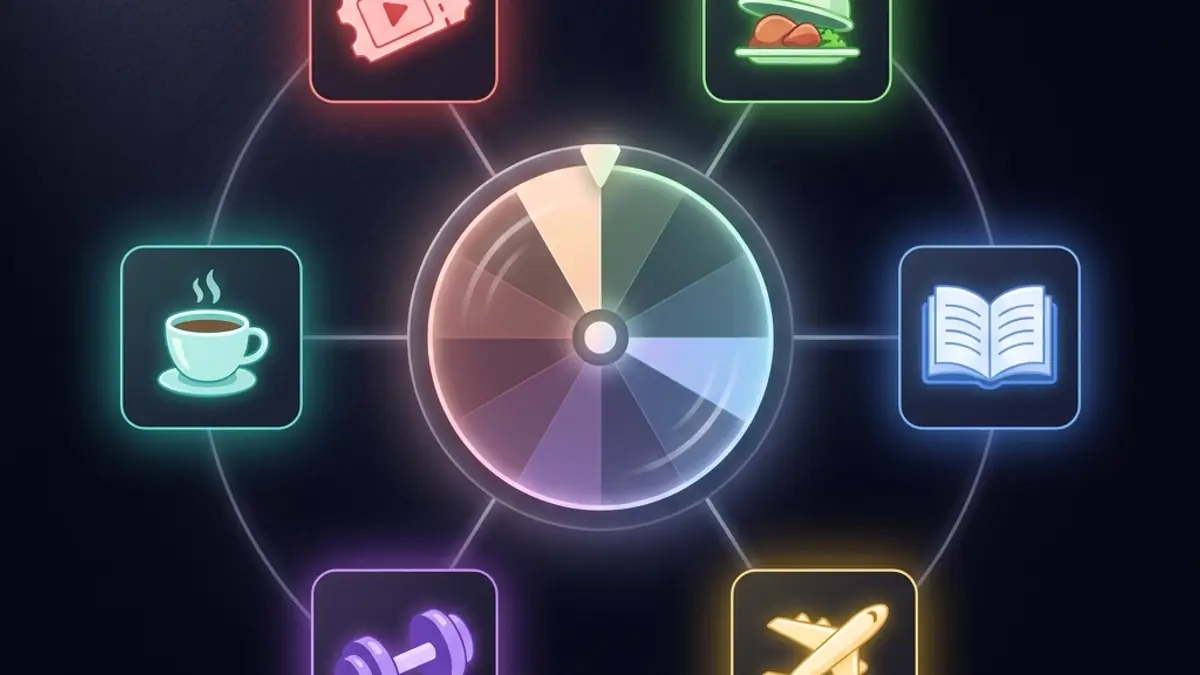
Here's why you get stuck. Your brain is wired to spot potential downsides. It's a survival thing. Any option you consider, your mind automatically surfaces reasons it could go wrong. The more you think about an option, the more downsides you generate.
When options are roughly equal, this creates a loop. You lean towards option A, your brain surfaces a downside of A, you lean towards option B, your brain surfaces a downside of B, and you're right back where you started. Every cycle of deliberation makes you less confident rather than more.
Researchers call this "analysis paralysis" and it's been studied extensively. The counterintuitive finding is that for decisions between roughly equal options, faster decisions lead to higher satisfaction than slower ones. The extra time doesn't improve the outcome. It just generates more anxiety about the outcome.
The decision wheel works because it stops the loop. You're not choosing anymore. You're accepting. And acceptance requires less psychological justification than choice. That shift is small but it matters a lot when you've been stuck for 30 minutes on which salad to order.
Decision Wheel for Groups and Teams
Solo decisions are one thing. Group decisions are where the wheel becomes genuinely powerful.
You know the scene. Five people trying to pick a restaurant. Everyone says "I'm fine with whatever." Nobody actually picks. 15 minutes of polite non-decisions. Eventually someone reluctantly suggests something and immediately says "but we don't have to go there" which means the group immediately does NOT go there.
The wheel fixes this. Everyone adds their suggestion. Everyone agrees beforehand that the wheel picks. Someone spins. Done. Nobody had to be the person who chose, so nobody feels responsible if it's not perfect. The wheel takes the social pressure out of group decisions.
I've seen teams use this for meeting topics, project prioritization, who buys the next round of coffee, and which conference talk to attend. Works every time because it removes the weird social dynamics of one person's preference overriding everyone else's.
Creative Uses for a Decision Wheel You Probably Haven't Thought Of
The "What Should I Do This Weekend" Wheel
Load it with: hike, museum, movie marathon, try a new recipe, reorganize the closet, game night, go to that market, read the whole afternoon. Spin it Friday night. Whatever it picks, that's Saturday's plan. The constraint of having a random plan is oddly freeing compared to the paralysis of infinite weekend options.
The Meeting Topic Prioritizer
Got five agenda items and only time for two? Put them all on the wheel. The first two spins pick which topics get discussed today. The rest carry over to next week. Removes the "who decides what's important" power dynamic from team meetings.
The Creative Direction Chooser
Designers and writers use this for creative decisions. Should the hero section be dark or light? Should the opening paragraph start with dialogue or description? Should we go bold or minimal? When creative decisions feel subjective and there's no objectively right answer, let the wheel break the tie.
The Workout Decider
Upper body, lower body, cardio, yoga, rest day. Put them on the wheel. Spin before the gym. Takes the "what should I do today" thinking out of your morning and replaces it with immediate action. Some personal trainers actually recommend this approach for breaking routine monotony.
The One Spin Rule: Why Re-Spinning Defeats the Purpose
Here's a trap people fall into. They spin the wheel, don't like the result, and spin again. Then again. Then again until they get the answer they were hoping for.
If you catch yourself doing this, the wheel already did its job. You now know what you wanted. The answer you kept hoping it would land on? That's your real choice. Go with it. Stop spinning.
Committing to the first spin is the whole point. Pre-commit before you spin by saying (out loud if needed) "whatever it picks, I'm doing it." That pre-commitment is what makes the wheel useful rather than just a procrastination tool with nice animations.
The commitment trick: Before you spin, say out loud "I will do whatever this lands on." It sounds silly. It works surprisingly well. The verbal commitment makes you take the spin seriously and pay attention to your gut reaction when the result appears.
How to Make Your Decision Wheel Right Now
You probably have a decision you've been sitting on right now. Maybe that's even why you're reading this article. Good news: it takes about 15 seconds to set up.
Go to the NameWheel decision wheel. Type your options. Spin. Accept the first result. Or notice your gut reaction and use that instead. Either way, you've made a decision. That's the hard part and it's already behind you.
The wheel doesn't make perfect decisions. Nobody does. But it makes fast decisions, and for the kind of choices where speed matters more than perfection, that's exactly what you need.
Try the Decision Wheel Now
Free, no signup, works on any device. Add your options and let the wheel pick.
Open the Decision WheelFrequently Asked Questions
Indie developer and the person who built NameWheel because every existing wheel spinner was either cluttered or required a login. Writes about random selection tools, classroom tech, and decision making. More about Abd.